

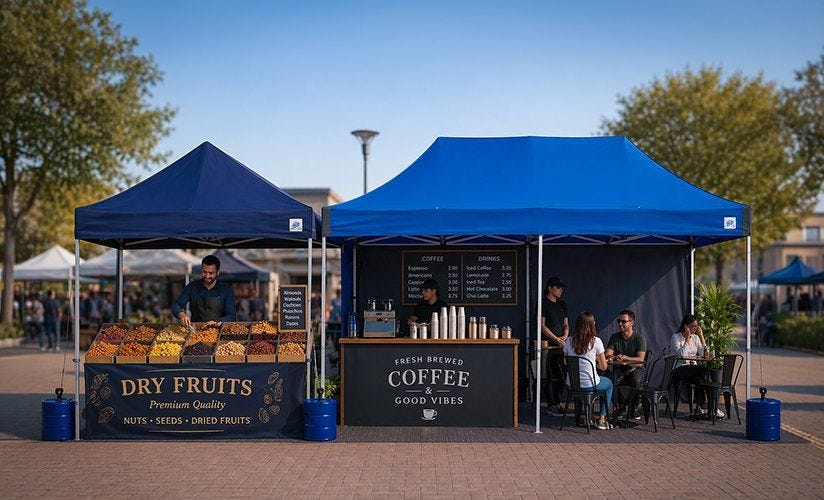
You've seen it happen at farmers markets and trade shows. One vendor is working out of a setup that looks sharp, branded, organized, plenty of breathing room. The booth next to them has the same product, half the traffic. Not because the product is worse. Because the tent is wrong for the space.
A canopy tent is one of those purchases that seems simple until you get it wrong. Most buyers find out on the day of the event, when tables are spilling past the legs and there's no room to turn around. The sizing conversation is worth having before that happens.
Here's a practical canopy tent size guide USA that lets you understand canopy tent sizes, and why getting this right makes every event easier.
Start with the Space You're Assigned, Not the Tent You Like
This gets skipped more than it should.
Most outdoor markets and trade shows in the U.S. assign each vendor a standard 10x10 booth. That's the floor space you get… full stop. Buying a 10x15 E-Z UP tent and showing up expecting to fit it into a 10x10 assigned square doesn't work. You'll be pushing into your neighbor's space before the first customer walks by. Check your event's space allocation first. Once you know what you're working with, then figure out what goes inside it.
The 10x10: Why It's Still the Standard
A hundred square feet sounds small. In practice, it's enough for a well-run vendor booth.
Two tables, a back wall, two people working…that fits. Customers can step up to the front, browse, and have a conversation without bumping into the person behind them. The 10x10 E-Z UP Eclipse® canopy tent is what you see at most professional setups because it does exactly what it needs to do without making the logistics complicated. It transports in one roller bag, sets up solo in under a minute, and fits the standard 10x10 booth without any negotiations at check-in.
The Eclipse® specifically became one of the best 10x10 canopy tent USA for a reason that has nothing to do with marketing. It blocks 99% of harmful UVA and UVB rays, which matters a lot more after hour six of an outdoor event than it does on a product listing page. Vendors running summer craft fairs or beach events aren't just buying shade, they're buying protection that holds up through a long day.
The 10x15: The Most Underrated Upgrade
This is the size that doesn't get talked about enough.
The 10x15 gives you 150 square feet. That extra five feet running the depth of the tent sounds modest. In a real event setup, it's significant. Food vendors use that space for prep. Product-demo setups use it to keep gear out of the customer lane. Teams with two people use it so nobody is constantly stepping around each other.
Think about what a 10x10 booth usually looks like when it starts feeling cramped…the prep table pushed against the display, customers hesitating at the opening because there's no clear place to step in, the second staff member basically standing outside the tent to stay out of the way. The 10x15 solves all three of those issues. It's the right call for vendors growing into their second or third season. The operation has evolved past one table and one function, and the footprint should match that.
The 10x20: Built for Full Operations
At 200 square feet, this isn't a bigger tent. It's a different kind of setup.
Two or three tables, product racks, a demo station, seating, multiple staff members moving without crowding…the 10x20 makes all of that possible. Customers can walk through rather than approach from one fixed point. It feels less like a stall and more like a real branded space.
The E-Z UP Vantage™ 10x20 is the go-to option in this range. Commercial-grade frame, same fast one-piece setup as the smaller shelters, full 200 square feet without extra hands required to put it up. Teams running brand activations, large-scale outdoor promotions, outdoor dining concepts, or events with multiple working zones will find it's exactly the right scale.
This size also opens up the full custom branding conversation. E-Z UP's in-house digital printing process, the award-winning one that produces rich, vibrant graphics built to last for years, is particularly impactful at the 10x20 scale. A well-branded shelter this size has real visual presence. You see it from across the event grounds.
Beyond 10x20: The Specialty Sizes Worth Knowing
The standard sizes cover most use cases, but E-Z UP's catalog goes further.
The 5x5 is ideal for ticket booths, compact add-ons, or changing stations at sporting events. It's not a primary setup, it's a supplement.
The 8x8 and 8x12 options split the difference between the 5x5 and the 10x10, useful when you need more than a table but don't have the full footprint of a standard booth.
The 12x12 and 13x13 sizes work for teams that need a wider square footprint without committing to a rectangular layout. Certain event formats work better with a square setup, and these cover that specific need cleanly.
Closing Thought
Getting the best pop up canopy tent size for vendors and trade shows right the first time comes down to one thing, being honest about how your setup actually operates, not how you hope it will.
Most vendors buying their second canopy tent choose bigger. Not because the first one broke, but because the business grew and the tent didn't. If you can map out your setup honestly, every table, every function, every person working inside it, you'll land on the right size and not have to figure it out again six months from now.
E-Z UP has been building these shelters since 1983, starting from a garage in Southern California and now operating in over 100 countries. The lineup covers everything from a 5x5 ticket booth to a full commercial shelter for industrial use. The sizing decision is yours to make. This guide just makes it easier to make it right the first time.
FAQs
How many people fit under a 10x10 canopy tent?
Two to four people working is the sweet spot. Add a table or two and there's still room for customers to walk up. Squeeze in more than five or six and someone's always in someone else's way.
What is the difference between a 10x10, 10x15 and 10x20 canopy tent?
Honestly, it comes down to how many things you're trying to do at once. One table, one job… 10x10 is fine. Two zones or a second person prepping in the back…that's a 10x15 situation. Running a full team with customers actually walking through…that's what the 10x20 is for.
Can I combine two 10x10 canopy tents into a 10x20?
Yeah, it works. People do it all the time as a workaround. Just know that the seam between the two frames is where rain collects, and it'll never feel as solid as one proper 10x20 unit.
How to choose canopy tent size for a business?
Don't just picture the tables, picture the whole day running. Staff moving, customers coming in, prep happening somewhere that isn't the display area. If that mental image feels cramped in a 10x10, it will be cramped in a 10x10.
What size canopy tent do I need for a farmers market?
Check with the market first because most lock you into a 10x10 space anyway. If you've got the option to go bigger and your setup actually needs it, the 10x15 is the one most vendors wish they'd bought the first time.